Liberators feature real-life historic weapons. Once praised by General Patton as “the greatest implement of battle ever devised” the M1 Garand was a seminal weapon throughout WWII. It was a semi-automatic rifle whose tremendous firepower gave the Allies a notable advantage over Axis troops. The M1 allowed its users to maintain significantly higher rates of fire, while also offering exceptional penetrating power.

The M1 Garand (officially called US Rifle, .30 caliber, M1, later simply as a rifle, .30 caliber, M1, as US Rifle, .30 caliber, M1.) Is a semi-automatic rifle chambered for the 0.30 - 06 Springfield rifle cartridge used by the US Army from 1936 to 1957 The rifle is named after its designer John Garand. It was the first standard issue semiautomatic military rifle. As "the greatest battle implement ever devised" by General George S. Patton, the Garand officially the bolt-action M1903 Springfield replaced as the standard service rifle of the United States Armed Forces in 1936 and was subsequently replaced by the selective-fire M14, starting During the Second World War, which gave M1 compels us in 1957., a distinct advantage in firefights against its axis enemies as standard issue rifle were more effective than the axis "slow burning BOLT-ACTION RIFLES. The M1 continued in large numbers until 1963 and to a lesser degree until 1976. Like its predecessor, used the M1 from the Springfield Armory was built. Today the M1 is in use for drill purposes.
The M1 is an air-cooled, gas-operated, clip-fed, semi-automatic, shoulder-fired weapon. That is, the air cools the cylinder; that the power to the gun chamber and the subsequent round comes from the expanding gas the previous round fired Hahn; that an en-bloc loaded by inserting (that is, it goes into action and the functions of the rifle as part of the rifle) metal clip (with eight laps) in the receiver; and that the gun fires each time the trigger is pulled a round. After eight rounds were shot, the empty clip is ejected automatically with an audible "ping" noise.

The M1 was the standard issue service rifle of the US armed forces in World War II and the Korean War, and also saw limited service in the Vietnam War. Most M1 rifles were issued to the US Armed Forces, even though many thousands were also borrowed or as foreign aid, made available to American allies. The Garand is still used by drill teams and military honor guard. It is also widely sought after by the civilian population as a hunting rifle, target rifle, and military collectors.
Although the name "Garand" is often pronounced / ɡərænd / according to experts and people who knew the weapon John Garand designer / ɡærənd / (with messenger rhyme) preferred. It's marksmanship program for American civilian property by the Civilian.
See how the M1 Garand plays its role in Liberators!
Liberators features historic World War II battles. Often called the beginning of the end for Nazi Germany, the Allied storming of Omaha Beach on the coast of Normandy was a bloody but triumphant affair. What changes will you make when your soldiers go charging toward the war-torn shore?

Omaha Beach was the codename for one of the five sectors of the Allied invasion of occupied France in Germany in the Allies on 6 June 1944, during the Second World War. Omaha is located on the coast of Normandy, France, facing the English Channel, 8 km (5 miles) long, from east of Sainte-Honorine-des-Pertes west of Vierville-sur-Mer on the right bank of the Douve River estuary , Landings were here to visit the British landings at Gold connect with the American landing in Utah with the East to the West, creating a continuous supply to the Normandy coast of the Bay of the Seine necessary. Among Omaha it was the responsibility of US Army soldiers, the British Royal Navy are provided with the maritime and naval gunfire support from the United States Navy and elements.
On D-Day, the untested 29th Infantry Division, are managed directly from Pointe du Hoc, together with nine companies of US Army Rangers, Sturm should the western half of the beach. The battle-hardened 1st Infantry Division was given the eastern half. The first assault waves, consisting of tanks, infantry and pioneers forces were carefully planned to reduce the coastal defenses and thus, end up the larger ships of the follow-up waves around.
The primary objective at Omaha was a bridgehead of about eight km (5 miles) to secure depth, between Port-en-Bessin and the Vire River, linking with the British landings at Gold to the east, and the achievement of the area of Isigny to connect the west with VII Corps landing at Utah. Against the landings was the German 352nd Infantry Division, a large proportion of them were teenagers, though they were supplemented by veterans who had fought on the Eastern Front. The 352nd was never a battalion or regimental training. Of the 12,020 people of the division, only 6,800 were experienced combat troops, detailed to defend a 53 km (33 Miles) forward. The Germans had been largely implemented in bases along the coast-German strategy is based on defeating any seaborne assault at the water line. Nevertheless, given Allied calculations indicate that Omaha's defenses were three times as strong as the one that she had met during the Battle of Kwajalein and its defenders were four times as many.
Very little went as planned during the landing at Omaha. Difficulties in navigation caused the majority of landing craft to miss their targets throughout the day. The defense was unexpectedly strong and inflicted heavy casualties during the landing of US troops. Under heavy fire, the engineers struggled to the beach obstacles; later landings for the few channels that have been deleted bundled. Weakened by the losses made only during landing, was the surviving stormtroopers not heavily defended exits clear from the beach. This led to further problems and therefore delays for later landings. Small penetrations were eventually by a group of survivors making improvised assaults achieved, scaling the cliffs between the most defended points. By the end of the day, two small isolated points was obtained, which were then inland exploited against weaker defenses further, thus achieving the original D-Day objectives over the following days.
Relive the Omaha Beach battle in Liberators!
Players will be able to recruit 35 Commanders during the Closed Beta. All Commanders in LIBERATORS are based on real people who took part in WWII. Each Commander comes with a unique unit, skills and attributes that will play a key role in how your army fights. How your Commanders interact with each other during battles can have many different outcomes, so choosing the perfect formation is crucial to any successful campaign. Recruitment will be possible via Commander Points, which can be acquired in countless ways on the map and through special events.
Léo Major
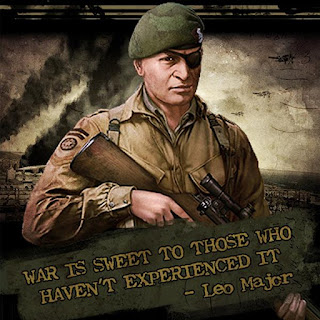 The Dutch town of Zwolle will always remember how Canadian Sergeant Léo Major single-handedly liberated it from German army occupation. On D-Day, he captured a German armored vehicle by himself, acquiring secret army codes for the Allies.
Sergeant Léo Major DCM* (1921 – 12 October 2008) was a French Canadian soldier in the Régiment de la Chaudière in World War II. He was the only Canadian and one of only three soldiers in the British Commonwealth to ever receive the Distinguished Conduct Medal twice in separate wars.
On the night of 13 April 1945, Major single-handedly liberated the city of Zwolle in the Netherlands from German army occupation. This action earned him his first Distinguished Conduct Medal. He received his second DCM during the Korean War for leading the capture of a key hill.
Major died in Longueuil on 12 October 2008 and was buried at the Last Post Fund National Field of Honour in Pointe-Claire, Quebec. He was survived by: Pauline De Croiselle, his wife of 57 years; four children; and five grandchildren.
Audie Murphy
"Praise be to God for this capture sod
That rich with blood does seep
With yours and mine like butchered swine
And hell is six feet deep"
Hailing from a humble background and with little more than his unrelenting resolve, Audie Murphy is one of the most accomplished soldiers in American history. Single-handedly holding off German soldiers then leading a successful counterattack while out of ammunition and wounded, he truly is a force to be reckoned with.
Audie Leon Murphy (20 June 1925 – 28 May 1971) was one of the most decorated American combat soldiers of World War II, receiving every military combat award for valor available from the U.S. Army, as well as French and Belgian awards for heroism. At the age of 19, Murphy received the Medal of Honor after single-handedly holding off an entire company of German soldiers for an hour at the Colmar Pocket in France in January 1945, then leading a successful counterattack while wounded and out of ammunition.
Murphy was born into a large sharecropper family in Hunt County, Texas. His father abandoned them, and his mother died when he was a teenager. Murphy left school in fifth grade to pick cotton and find other work to help support his family; his skill with a hunting rifle was a necessity for putting food on the table. Murphy's older sister helped him to falsify documentation about his birth date to meet the minimum-age requirement for enlisting in the military, and after being turned down by the Navy and the Marine Corps he enlisted in the Army. He first saw action in the Allied invasion of Sicily and the Battle of Anzio, and in 1944 was part of the liberation of Rome and invasion of southern France. Murphy fought at Montélimar, and led his men on a successful assault at the L'Omet quarry near Cleurie in northeastern France in October.
After the war, Murphy enjoyed a 21-year acting career. He played himself in the 1955 autobiographical To Hell and Back based on his 1949 memoirs of the same name, but most of his films were westerns. He made guest appearances on celebrity television shows and starred in the series Whispering Smith. Murphy was a fairly accomplished songwriter, and bred quarter horses in California and Arizona, becoming a regular participant in horse racing.
Suffering from what would today be termed post-traumatic stress disorder (PTSD), he slept with a loaded handgun under his pillow and looked for solace in addictive sleeping pills. In the last few years of his life he was plagued by money problems, but refused offers to appear in alcohol and cigarette commercials because he did not want to set a bad example. Murphy died in a plane crash in Virginia in 1971 shortly before his 46th birthday, and was interred with full military honors at Arlington National Cemetery.