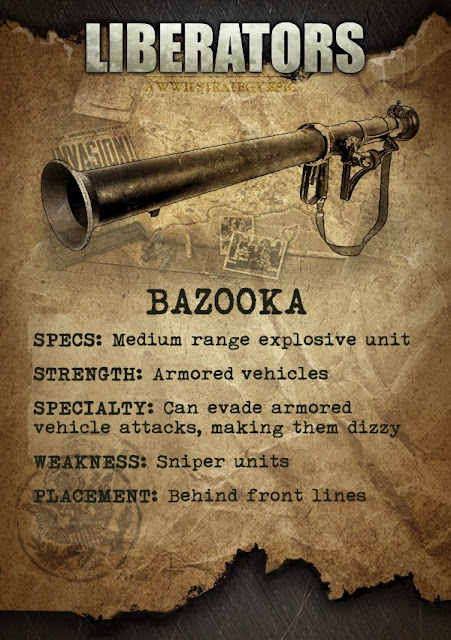
Liberators features real-life weapons and equipment in World War II. Due to its ease-of-use, simple maintenance and operation, as well as fewer restraints on mass production, the M1 “Bazooka” became an indispensable tool for the war effort. Eisenhower cited the Bazooka as one of the major contributors to the Allied victory. It was useful against tanks and to assail fortified positions.
Bazooka is the common name for a man-portable recoilless antitank rocket launcher weapon, widely fielded by the United States Army. Also referred to as the "Stovepipe", the innovative bazooka was among the first generation of rocket-propelled anti-tank weapons used in infantry combat. Featuring a solid rocket motor for propulsion, it allowed for high-explosive anti-tank (HEAT) warheads to be delivered against armored vehicles, machine gun nests, and fortified bunkers at ranges beyond that of a standard thrown grenade or mine. The bazooka also fired a HESH round, effective against buildings and tank armor. The universally applied nickname arose from the M1 variant's vague resemblance to the musical instrument called a "bazooka" invented and popularized by 1930s U.S. comedian Bob Burns.
During World War II, German armed forces captured several bazookas in early North African and Eastern Front encounters and soon reverse engineered their own version, increasing the warhead diameter to 8.8 cm (among other minor changes) and widely issuing it as the Raketenpanzerbüchse "Panzerschreck" ("Tank terror").
The term "bazooka" still sees informal use as a generic term referring to any ground-to-ground shoulder-fired missile weapon (mainly rocket propelled grenades).
Secretly introduced through the Russian front and in November 1942 during Operation Torch, initial production versions of the launcher rocket M1 and M6 were hastily supplied to some of the US invading forces during the landing in North Africa. On the night before landing, General Dwight D. Eisenhower was shocked to find out from a subordinate that none of its troops had received any instruction in the use of the bazooka.
Initially supplied with M6 rocket highly reliable and untrained, the M1 did not play a significant armed role in combat in the North African struggle, but did provide a stroke of German intelligence when some were captured by the Germans in first encounters with inexperienced US troops . A US general visits ahead of Tunisia in 1943 after the end of combat operations could not find soldiers who could report that the gun had actually stopped an enemy tank. Another issue bazooka was suspended in May 1943.
During the Allied invasion of Sicily, a small number of M1A1 Bazooka (using an improved rocket, the M6A1) were used in combat by US forces. The M1A1 was responsible for four average German tanks and heavy Tiger I, with the latter being knocked out by an unlikely hit across the gap to the driver. A major drawback to the bazooka was the big backblast and smoke trail (in colder weather), which gave the position of the shooter, forcing rapid relocation of the squad. Furthermore, the bazooka fire staff often have to expose their body, in order to obtain a clear field of fire against an armored target. Casualties among the members of the bazooka team were extremely high during the war, and assignment of such rights in the face of German counterfire was generally regarded by other members of the squad not only as highly dangerous, but almost suicide.
When the existence of the bazooka was revealed to the American public official press release for the first two years stated that "packed the punch of a 155 mm cannon" -a great exaggeration, but widely accepted by the American public at the time.
At the end of 1942, the number of production early American M1 bazookas were captured by German troops of the Russian forces which received amounts of bazooka under Lend-Lease as well as during Operation Torch invasions in the North African Campaign. The Germans quickly developed its own version of the gun, increasing the diameter of the warhead of 60 mm to 88 mm (2.4 to 3.5 inches). In German service, the bazooka was popularly known as the Panzerschreck. The German weapon, with its larger warhead, more powerful, had significantly higher armor penetration; ironically, calls for a warhead larger diameter had also been raised by some officers of artillery during rehearsals US M1, but were rejected. After participating in an armor penetration test involving a German Panther tank using either Raketenpanzerbüchse or RPzB 54 Panzerschreck and bazooka US M9, the Donald E. Lewis cable from the US Army informed his superiors that the Panzerschreck was "far superior to American bazooka ":" I was so favorably impressed [by Panzerschreck] I was ready to take after the Krauts with his own weapon.
The bazooka M1 fared much better on the rare occasions that could be used against the much thinner armor usually mounted on the underside, top and bottom of enemy tanks. To hit the bottom panel of an enemy tank, bazooka operator had to wait until the tank was overcome a steep hill or other obstruction, to hit the top armor usually required fire the rocket from the top floor of a building or position high like. During 1944 Allied offensive in France, where some examples of connecting plane with the US Army began to be experimentally in armed camp, and were flying in pairs or quartets of American military equipment - and most notably used during the Battle of Arracourt - Major Charles "Bazooka Charlie" Carpenter assembled a battery of three bazookas M9 on the-fuselage wing brackets on either side of his L-4 Grasshopper aircraft in order to attack the enemy's armor, and was credited with six destruction tanks enemies, including two Tiger I heavy tanks.
Despite the introduction of bazooka M9 with its most powerful rocket, the M6A3-in late 1943, gun effectiveness of reports against enemy armor decreased alarmingly in the last stages of World War II, as new German tanks with thicker and better designed armor plate cast and armor skirts / armor spaced were introduced. This development has forced the operators to target bazooka less well protected areas of the vehicle, such as rails, sprockets, bogey wheels or rear engine compartment. In a letter dated May 20, 1944, General George S. Patton told a colleague that "the purpose of the bazooka is not to hunt tanks offensively, but to be used as a last resort to keep the tanks from invading infantry. to ensure this, the interval should be carried out at about 30 yards. " The extreme difficulty of closing the grenade-throwing unnoticed distances before hitting targets small spot on an enemy tank helps explain the high male death rate attributed to the duty to launch anti-tank rockets.
Campaign in the Pacific, and in North Africa, the original bazookas sent to combat reliability problems often had. The trigger circuit operates on battery was easily damaged during rough handling, and rocket engines often failed due to high temperatures and exposure to moisture, salt spray or humidity. With the introduction of the M1A1 and its most reliable rocket ammunition, the bazooka was effective against some fixed Japanese infantry positions such as bunkers of small arms and pill boxes concrete. Against emplacements coconut and sand, the weapon was not always effective, since these softer structures often reduced the force of impact of the warhead enough to prevent the detonation of the explosive charge. Later in the Pacific war, most infantry and marine units often used the flamethrower M2 to attack such placements. In the few cases in the Pacific, where the bazooka was used against tanks and armored vehicles, rocket warhead easily penetrated the thin armor plate used by the Japanese and destroyed the vehicle. Overall, the M1A1, M9 and M9A1 rocket launchers were seen as useful and effective weapons during World War II, although they were mainly used against enemy fortifications and fixed positions, not as anti-tank weapons. General Dwight Eisenhower later described it as one of four "tools of Victory", which won World War II for the Allies (in conjunction with the atomic bomb, Jeep and transport aircraft C-47 Skytrain).
Make use of it today on the battlefield now! Visit Liberators Facebook Page for more information!
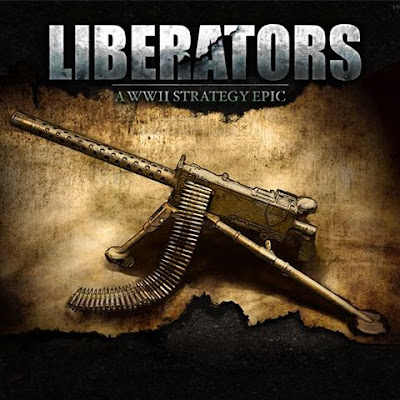
Liberators, developed and published by MutantBox, features real-life historic equipment in the Second World War. With a firing rate of 450 to 600 round per minute, the M1917 machine gun was a game-changer in the Second World War. Weight and volume meant it was used primarily as a defense or as a fixed support weapon battalion. piercing ammunition this weapon gave a decisive advantage over its predecessors.
Give it a shot on the battlefield as their first line of defense against infantry units.
The machine gun Browning M1917 is a heavy machine gun used by the armed forces of the United States in World War I, World War II, Korea and Vietnam in a limited degree; It has also been used by other nations. He was a crew served, belt-fed, water-cooled served alongside the much lighter air-cooled Browning M1919 machine gun. It was used at the battalion level, and often mounted on vehicles (eg a jeep). There were two main iterations of it: the M1917, which was used in World War II; and M1917A1; which it was used thereafter. The M1917, which was used in some aircraft and land on paper, had a firing rate of 450 rounds per minute; The M1917A1 had a firing rate of 450 to 600 rounds per minute.
In 1900, John Moses Browning filed a patent for an automatic weapon recoil engine. Browning did not work in the gun again until 1910, when a water-cooled design prototype 1900 was built Despite the gun worked well, Browning improved the design slightly. Browning substituted lower side ejection ejection, added a buffer for smoother operation, replaced the hammer with a hammer two-piece and some other minor improvements. The basic design of the gun was still designing 1900.
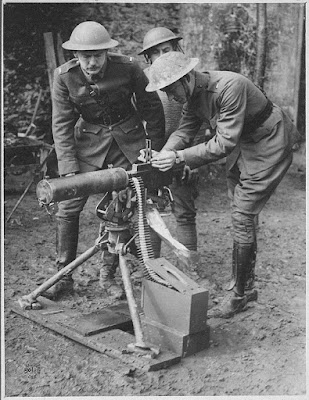
Browning is a water-cooled heavy machine gun, although some experimental versions were made that did not use a water jacket; air-cooled M1919 was subsequently developed as a medium machine gun. Unlike many other early machine guns, the M1917 had nothing to do with the design of the lock lever Maxim. At 47 pounds (21 kg) [clarification needed], which was much lighter than modern weapons of Maxim type as the first 137 lbs (62 kg) German Maschinengewehr 08 (08/15 model: 43 lb (20 kg)) and the British Vickers machine gun, while remaining highly reliable. The only similarities with Maxim or Vickers are the operating principle recoil, the breech block T-slot, "pull-out" feed belt, water cooled, and before ejection. Its locking mechanism keeps sliding-block weight and complexity, and was used in many previous designs Browning. The Belt Fed left to right, and the cartridges are stacked closer together than Maxim / Vickers (patterns copied by most of the weapons later.)
The Department of the Army Ordnance showed little interest in the guns until the war broke out in April 1917. At that time, the US arsenal It included only 1,100 machine guns, and most of those who were out of fashion. The government asked several designers to present arms. Browning organized a test at the Springfield Armory in May 1917. In the first test, the weapon fired 20,000 rounds without incident. Reliability was exceptional, so Browning fired another 20,000 rounds per gun, no piece fails. Ordnance Board was impressed but was not convinced that the same level of performance could be achieved in a production model. Accordingly, a second weapon Browning used not only doubles the original trial, but also continuously fired for 48 minutes and 12 seconds (over 21,000 rounds).
The Army adopted the weapon as its principal heavy machine gun, using the flat M1906 30-06 cartridge with a 150-grain bullet base. Unfortunately, production was a problem. Several manufacturers started producing the gun, but had to establish production lines and tooling. The June 30, 1918, Westinghouse had only 2,500 and Remington had only 1,600. At the time of the Armistice, Westinghouse had 30,150, 12,000 Remington and Colt 600.
Until the beginning of World War I, the Army had used a variety of larger MGs, as the M1895 Colt-Browning machine gun "Potato" (which Browning had also designed) and weapons like the Maxim Gun, the M1909 Benet- Mercié and Hotchkiss M1914 machine gun. Though the 1917 model was destined to be the director of the US Army heavy machine gun in the war, the army was in fact forced to buy many foreign weapons - machine gun-produced French Hotchkiss 8mm was actually the largest heavy machine gun used by the American Expeditionary Force.
In 1926, the rear view of the Browning was revised to incorporate the scales for both the new M1 ball (172-grain bullet boat-tail) and M1906 (-base flat Bullet 150 grain) ammunition. M1 ball, the M1917 had a maximum range of about 5,500 km (5,000 m); M2 ammunition, about 3,500 yards (3,200 m). [9] The rear sight had a view of the battle as well as a blade type suitable for use raised view either against ground or air targets.
The M1917 saw limited service in the last days of World War I. Because of production delays, only about 1,200 models 1917s saw combat in the conflict, and only in the last two months and a half of war. Some were too late for combat service. For example, the 6th Machine Gun Battalion, fighting as part of the second division not exchange their guns Hotchkiss M1914 to M1917 Browning machine guns until Nov. 14, three days after the armistice. The United States equipped about a third of the divisions sent to France; the others were also equipped with machine guns bought for the British Vickers machine guns built by Colt in the US French or. Where did the Model 1917 see action, its rate of fire and reliability were very effective. [Citation needed] The M1917 weapon system was lower than the Vickers and Hotchkiss guns because cartridges England and France had range of about 50 percent longer than the 30 -06 cartridge service used in World War II
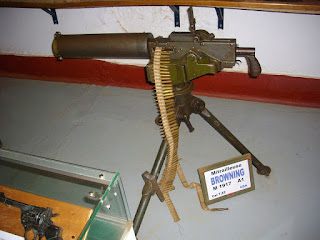
The Model 1917A1 was used again in the Second World War, and is used primarily with the ball M2, tracer and armor-piercing ammunition introduced just before the start of hostilities. Some were supplied to the UK for use by the Guard and the entire production of 0.303 Vickers was needed to replenish the abandoned during the fall of France team. weight and volume of the M1917 meant it was generally used as a defense or as a fixed battalion or regiment support weapon. In the fierce battle Momote runway in Admiralties, machinegunners 5th Cavalry US Army killed several hundred Japanese in one night using their Browning M1917; a gun was left in place after the battle as a monument to the desperate struggle.
The Model 1917 was called to service again in the Korean War. On at least one occasion, US troops in the Korean War urinated in the gun when the water cooling failed in the cold Korean winter temperatures. The Model 1917 was eliminated slowly out of military service in the late 1960s in favor of the M60 machine gun cameras much lighter in the new cartridge 7.62mm NATO.
The attributes of the Model 1917 (and similar weapons, such as the Vickers machine gun) -Evaluation continuous fire from a static position-had been rendered useless by the transition to highly mobile war. Many of the 1917s were given to South Vietnam. The last regular service of the United States was during infiltration machine gun in Fort Benning, Georgia, where his sustained ability of the fire was an advantage in long nights to shoot over the heads of students under trace. Gun continue to see service in some armies of the Third World and in the second half of the 20th century Some are still in use today by irregular military forces because its water-cooled barrel allows long periods of sustained fire.
Visit Liberators Facebook Fanpage to get more information on the game!
In Liberators, Commanders lead armies composed of specialized units, each unique to a given Commander. Upgrading and leveling up will reveal their ultimate potential, and add to users’ flexibility of strategy in battle.
Unit Description
At present there are 10 separate Units, each with custom appearance and features. As different arrangement of units will bring hundreds of different result, users are encouraged to experiment with different strategies and share their findings.
Unit Status
Equip units with gear to level up;
Commander’s strength is heavily dependent upon their level. Keep Commanders at their highest level through EXP books and managing equipment level
Equipment
Commander’s strength is influenced by which items they have. As Commanders increase their level, they are able to access different types of items. Be sure to keep them maximally equipped to increase your power on the battle field.
Units Features
As Commanders increase their levels, they will unlock new features specific to their units. Each Commander’s units can have at most 4 special features. The following comprehensive list of all possible features.
Features description:
Crouch: Chance to dodge Long Range Infantry Units normal attack
Emplacement: Chance to block Long Range Infantry Units normal attack, reduce 50% DMG
Flank: Chance for a Crit attack on Long Range Infantry Units, deals double DMG
Prone: Deal extra DMG in normal attack against Close Combat Infantry Units
ZigZag: Chance to dodge Close Combat Infantry Units in normal attack
Hatch Down: Chance to block Close Combat Infantry Units in normal attack
Armor-piercing: Deal extra DMG for normal attack against Motorized Units
Czech Hedgehogs: Reduce RECEIVED DMG when attacked by Motorized Units
Armor-piercing: Deals extra DMG in normal attack against Motorized Units
Crouch: Chance to dodge Motorized Units normal attack
Bayonett Charge: Chance to have continuous attack in normal attack against Long Range Infantry Units
Bulletspray: Chance to have strafe attack in normal attack against Long Range Infantry Units
Bayonett Charge: Chance to have a continuous attack when normal attack Long Range Infantry Units
Explosive Bullet: Chance to stun enemy in normal attack against Close Combat Infantry Units
Terror on Wheels: Chance to have strafe attack in normal attack against Close Combat Infantry Units
Tank Blast: Chance to deal Super Crit attack (triple DMG) in normal attack against Close Combat Infantry Units
Explosive Shell: Chance to stun enemy in normal attack against Motorized Units
Barrage: Chance to haveCrit attack on Motorized Units, deal double DMG
AT Rush: Chance to ignore defense in normal attack against Motorized Units
HEAT Round: Chance to stun enemy in normal attack against Motorized Units
Grenade Toss: Deals DMG when attacking AT Gun units, also reduces DMG from it.
MG Suppress: Deals DMG when attacking Riflemen units, also reduces DMG from it.
Satchel Charge: Deals DMG when attacking Mortar units, also reduces DMG from it.
Precise Kill: Deals DMG when attacking Bazooka units, also reduces DMG from it.
Jeep Rush: Deals DMG when attacking Paratrooper units, also reduces DMG from it.
Nest Breaker: Deals DMG when attacking Machine Gun units, also reduces DMG from it.
Recon Tracker: Deals DMG when attacking Recon units, also reduces DMG from it.
Sniper Elimination: Deals DMG when attacking Sniper units, also reduces DMG from it.
Tank Buster: Deals DMG when attacking Tank units, also reduces DMG from it.
Artillery Breaker: Deals DMG when attacking Artillery units, also reduces DMG from it.
Medic Support: Recovers HP before each turn.
Reinforcements: Increases upper limit of troop number
Headshot: Chance to have Super Crit attack when normal attack enemy, and deal Triple DMG
Reinforcements: Increase upper limit of troops number
Sand Bagged: Increases defense points
Creeping Barrage: Chance to have Sputter Attack against enemy, deals 50% DMG to enemies around it.
Sand Bagged: Increases defense points
Panzerschrekt Assault: Chance to have Crit Attack against enemy, deals Double DMG